This past week we ‘celebrated’ International Women’s Day with more to lament than celebrate. Far from making progress, women’s rights have been eroded in the past year. Agnes Callamard, secretary-general of Amnesty International, says that “events in 2021 and in the early months of 2022 have conspired to crush the rights and dignity of millions of women and girls,” naming the impact of the Covid-19 pandemic, the Taliban
take-over in Afghanistan, and Turkey’s withdrawal from the Istanbul Convention on Gender-Based Violence.
Amnesty International also warned that “catastrophic attacks on human rights and gender equality over the past twelve months have lowered protection and upped threats against women and girls across the globe.”
https://www.amnesty.org/
Since the Taliban take-over in August last year, girls over twelve may not attend school. Women may not work or travel in public without a male guardian, which means many women are effectively imprisoned at home. Many cannot seek urgent health care as they may not visit a health centre unless accompanied by a male chaperone.
Amnesty International also reports the widespread gang-rape of women, some as young as 14, by Tigrayan forces in the war in Ethiopia. Images from Ukraine show the devastating impact of the war on pregnant women and women fleeing with their children. According to the United Nations, seventy percent of those living in poverty are women, and eighty percent of those displaced by climate change disasters are women.
In South Africa, teen pregnancies jumped sixty percent during the pandemic due to, amongst other things, a high rate of rape, and lack of access to contraceptives, especially during the lockdown. According to the South African Medical Research Council, one in three women in South Africa experience gender-based violence and one in five children are sexually abused.
Femicide - the murder of a woman by her intimate partner - is at horrifying levels. The three pieces of new anti-gender-based-violence legislation signed into law last month will only make a difference to justice for survivors if they are effectively implemented.
Refugee women are being charged for pregnancy services at state hospitals. If they cannot pay, birth documentation for their child is withheld, and they cannot register their child with home affairs. Natural births cost from R5000-R8000 and R25000 for a caesarean which these women have no way of paying.
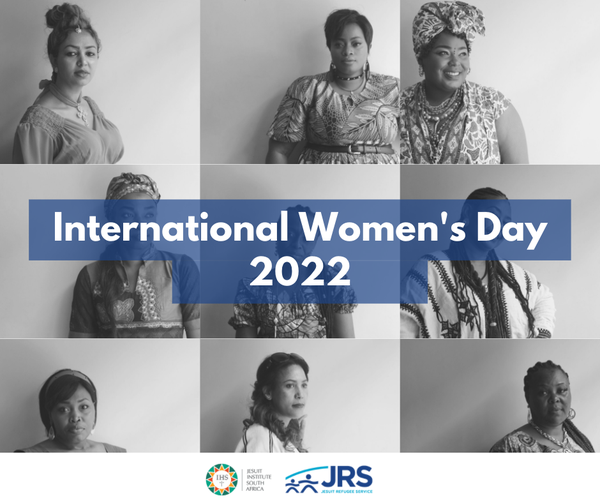
As part of International Women’s Day, Jesuit Refugee Services Southern Africa asked women in their livelihoods program: “How would the world be different if there was gender equality?” Here are a few of their responses:
“There would be no hunger.”
“We would all be mothers.”
“There would be a balance in society.”
“It would be a strong world.”
Where women’s rights and dignity are being violated, where their sexuality is violated, where they are excluded from education and prevented from accessing the means to flourish, where women bear a disproportionate burden of the consequences of conflict and ecological disasters - we have to keep speaking out.
All of us, women and men, are called to raise our voices for women whose voices are being silenced and for whom womanhood – which should be cause for celebration – is a sometimes deadly liability.