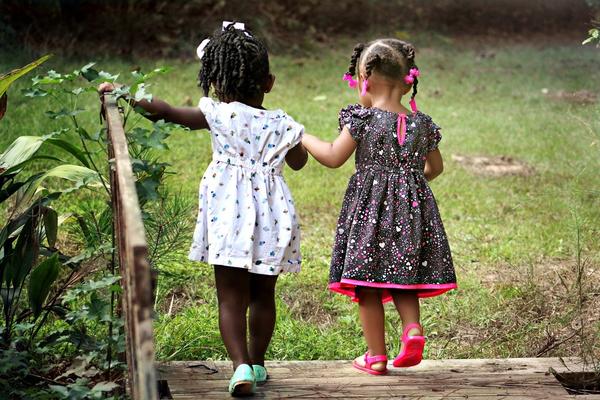
“But Jesus called the children to him and said, ‘Let the little children come to me, and do not stop them; for it is to such as these that the kingdom of God belongs. In truth I tell you, anyone who does not welcome the kingdom of God like a little child will never enter it.’”
(Luke 18:16-17)
I have always been very interested in the growth and development of young children. More recently, I have become very drawn to the spiritual development of children. Young children, especially, are born with inquisitiveness and intuition that is gradually shaped and altered by the adults they come in contact with. It is our role as adults to guide and nurture our children in the ways of the world. Spirituality and a relationship with God form part of the journey. Lacy Finn Borgo, in her
dissertation Spiritual Direction with Children the Next Natural Step in the Christian Historical Progression of Children’s Spiritual Formation, says: “Children without a listening and guiding companion miss opportunities to build upon their connection with God and others.”
Children have spiritual experiences. Finn Borgo goes on to say, “Christians have struggled to understand or acknowledge, much less encourage, the reciprocal nature of a child’s life with God. Supporting the reciprocal nature of a child’s life with God includes acknowledging their full humanity by embracing childhood as a fully human state and therefore their need for a whole person spiritual formation.”
We need to accompany our children on their spiritual journey. It is important that we listen closely and encourage them to talk about their experiences of God, in whatever way or form, without enforcing our ideas and opinions on them.
As adults, we should practice “Holy Listening”. While, for example, children are talking and playing, listen for the good, beautiful and true in their stories. As adults, we should be encouraging children to know that God is always with them, no matter what, good or bad.
Many children are fortunate enough to attend Catechism or Sunday School or have some sort of spiritual formation, and these have, as Finn Borgo says, “helped us to understand, acknowledge and encourage a child’s life with God”. Accompanying children on their journey to Christ and with Christ is a way of fulfilling the words of Jesus, that children are participants in a life with God. Is it not, therefore, Finn Borgo says, our role to be or to provide a “listening companion who can help them
to recognize and respond to the movement of God in their lives?”