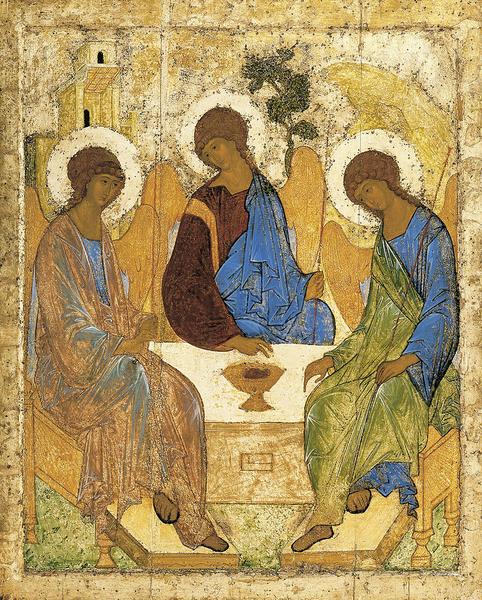
Look carefully at the icon. On the table, there is a cup. In the background, Rublev painted Abraham’s house, the Oak of Mamre and the mountain Moriah. The angels are seated so that the lines of their bodies form a full circle. The middle angel blesses the cup with a hand gesture. The figures faces depict them contemplating
eternity.
Notice something else: there are three angels but there is space for a fourth person around the table in the foreground. Rublev invites the viewer to take a seat and join them at the table.
Each of us – and the whole of humanity – is invited to sit at the table. We are invited to join the contemplative gaze of the angels as we listen to the dialogue of the Trinity. It is by listening to that dialogue, the language of God, that we too are drawn into and therefore invited to embody peace, unity, harmony, mercy, humility and love in our daily lives. We
are invited, in our lives, to make this icon a living reality.
It was Jesus, the second person of the Trinity, who became incarnate – one of us – to reveal the Trinity to us. Our belief in the Trinity is made explicit when we intentionally choose, daily, to live the very way of life and qualities of the Trinity. Each quality that the Trinity reveals gives us a deeper understanding of the person we call
‘God’.
Take time to look at Rublev’s icon. What qualities of God do you see in the icon? What qualities of the Triune God are you challenged to live in your own life today? Ask God to grace you with what you need: peace, unity, mercy, humility, love… or anything else you see in the icon.