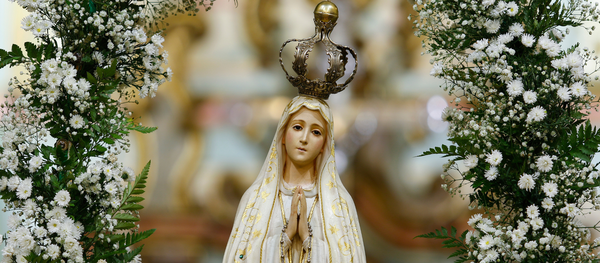
Other Christians occasionally accuse Catholics of worshipping Mary. They see us kneeling before statues of Our Lady, or praying with the rosary. But they misunderstand what we are doing. They don’t know that we are venerating Mary, the mother of Our Lord, and asking for her intercession. They don’t know the Church's teaching about Mary's
role in salvation history. She consented to be the mother of Jesus and is thus known as Mother of God. She collaborated with God in the work of salvation.
The Second Vatican Ecumenical Council was the highest teaching event of the Church in the 20th Century. At the council, 2151 of
the 2156 bishops from all around the world voted in favour of Chapter 8 of Lumen Gentium, the Dogmatic Constitution on the Church. The constitution puts Mary firmly INSIDE the Church, with the saints in heaven. Lumen Gentium 62 gives Mary the titles of Advocate, Auxiliatrix, Adjutrix, and Mediatrix. These titles mean that she advocates on our behalf; she helps God in the work of salvation; she comes to our aid; and she mediates between God and us. Nothing more,
nothing less.
The Dogmatic Constitution continues, “This, however, is to be understood that it neither takes away from nor adds anything to the dignity and efficaciousness of Christ the one Mediator… For no creature could ever be counted as equal with the Incarnate Word and Redeemer... The Church does not hesitate to profess this subordinate
role of Mary.”
Lumen Gentium 68 describes Mary glorified in body and soul in heaven as a “sign of sure hope and solace to the people of God during its sojourn on earth.”
At the time of the Council from 1962 to 1965, and subsequently, many Catholics wanted to attribute other titles to Mary – titles that place her role in the history of salvation on almost the same level as that of Jesus. However, at the council, the Church gently but firmly taught that it does no honour to Our Lady to attribute to her something that is not rightfully hers. We should avoid excessive devotions.
Barely thirty years later, several Catholics were petitioning the Congregation for the Doctrine of the Faith for the Church to add another title to those already given to Mary. So, Pope John Paul II asked for advice from theologians. Accordingly, at the Mariological Congress in Czestochowa in 1996, theologians from faculties and Mariological societies around the world unanimously advised the pope against
declaring another particular title as part of the teaching of the Church.
The proposed title was not in line with the extraordinary magisterial teaching of the Second Vatican Council. The implications of this new title, in terms of what they would mean for the Church’s traditional teachings about Jesus, salvation and the Holy Spirit, had
not been fully elaborated. In dogmatic definitions, there should be no room for ambiguity. A secondary reason that such an innovation would be inopportune is that it would have caused ecumenical problems with churches in the East and the West if the Catholic Church had unilaterally added another dogmatic title.
Mary has many names. Church
teaching has formally defined four dogmas: Mother of God (431); Ever Virgin (553); The Immaculate Conception (1854); The Assumption (1950). We can be most secure if everything we say about Our Lady is within the confines of these, and the four titles mentioned above (Advocate, Auxiliatrix, Adjutrix, and Mediatrix). It is best not to run ahead of the Church.