Gender-based violence (GBV) is not a new tragedy. It is an old story — one told in whispers, wounds, and the silences of families and communities across centuries. Even Scripture preserves painful accounts of violence against women: Hagar fleeing harm into the wilderness, Tamar’s desperate cries in the house of a powerful man, the unnamed
woman in Judges whose suffering becomes a sign of moral collapse. These stories remind us that GBV has long been woven into the social fabric of human history.
Gender-based violence is often spoken about in statistics, policies, and headlines — a crisis named in numbers. But for many women and children, the true story of GBV lives in the
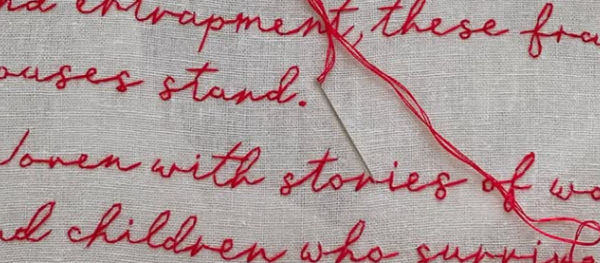
body: in memories that are hard to articulate, in silences that carry weight, and in the personal work of stitching together a sense of self after harm. I follow three South African women on social media platforms who are doing something quietly radical: using embroidery to tell the stories that have long been ignored or dismissed, transforming needlework into activism, lament, and meaning-making. Liezel Graham, who now lives in Scotland, calls herself a ‘storyteller and a narrative word stitcher’ using vintage textiles as her canvas – “at its heart, all my work is a personal conversation with myself” and a way of breaking the silence of the past.
Willemien de Villers, based in Muizenberg, has been stitching the stories of womanhood for many years. From her own childhood story of abuse, she says that “silence is a perpetrator’s best friend” and “a lingering effect of abuse, sexual or otherwise, is a sense of disconnection, and I’ve found it very helpful to
integrate my thoughts and feelings into my embroideries. The very act of stitching is healing, in that it allows chaos to transform into a calm order”.).
Nell-Louise Pollock’s ‘Mending Threads’ was recently showcased at the 5th Annual National Shelter Indaba (11-13 November 2025 at Birchwood Hotel and O R Tambo Conference Centre). Imagine
miniature shelters, adorned with intricate embroidery, each thread a testament to the strength and resilience of GBV survivors. These tiny sanctuaries hold within them stories of survival, courage, and the indomitable human spirit. A poignant reminder that even in the darkest moments, hope can still be stitched into the fabric of our communities (mendingthreads_nelllouise on Instagram)
Embroidery may appear delicate, but in these women’s hands it becomes powerful. Their work challenges the idea that activism must be loud, public, or confrontational. Crafting offers survivors an alternative language — one that is gentle yet insistent, quiet yet persistent, personal yet profoundly political. Through thread and fabric, they reclaim their stories on their own terms. They turn pain into pattern, memory into meaning, and isolation into
community in which every stitch tells a story.
In a country where GBV remains a national crisis, I find myself wondering in what other ways activism shows up and what other handmade acts of resistance might look like?